Women's Health Is Underresearched
We Need YOUR Experience!
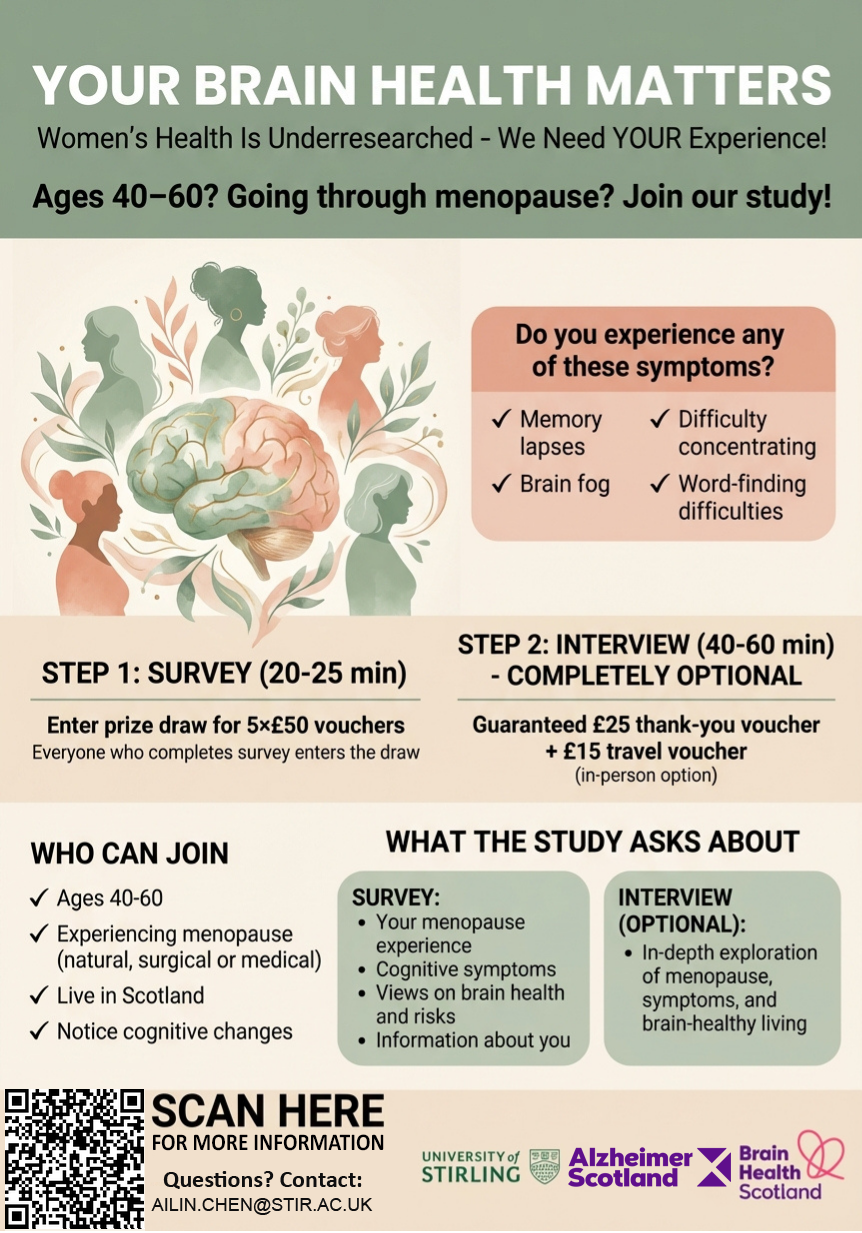
Join our study to help researchers understand the link between menopause and brain health. Your voice matters.
Know someone who might be interested?
Can I Join?
You can join if you:
Are aged 40–60
Are currently experiencing the menopause transition — including natural, surgical, or medically induced menopause
Were assigned female at birth (including cisgender women, transgender men, and non-binary individuals)
Live in Scotland
Can read and complete the survey in English and have access to the internet
Please note: You should not take part if you are currently pregnant or less than 12 months postpartum.
✓ If this sounds like you, you're eligible to participate!
About This Study
Why This Research Matters
Many women report changes in their thinking and memory during menopause — things like forgetfulness, difficulty concentrating, or 'brain fog'. These experiences are common and can be concerning. Some women worry whether these symptoms might be signs of future dementia.
Research shows that midlife (around ages 40–60) is an important time for protecting brain health and reducing dementia risk through lifestyle changes. This study explores how women experience and interpret these cognitive changes, and what motivates them to look after their brain health. Understanding this will help design better support, information, and healthcare approaches for women going through menopause.
This study does not suggest that dementia risk is caused by menopause. We recognise that many cognitive symptoms are common and potentially reversible.
Common Symptoms We're Studying
Who Is Running This Study?
This research is conducted by the University of Stirling, in association with Alzheimer Scotland and Brain Health Scotland.
Lead Researcher:
Ailin Chen, Doctoral Trainee Health Psychologist
Research Supervisor:
Professor Vivien Swanson
Contact:
Research Disclosure: This research forms part of a doctoral thesis at the University of Stirling. No external funding is received — the study is self-funded by the researcher. Alzheimer Scotland and Brain Health Scotland have provided advisory input and will help share findings. These organisations will not have access to your personal data. Ethics approved by the University of Stirling General University Ethics Panel — Reference: GUEP 2026 24859 20617.
How to Participate
There are two parts to this study. You can do one or both — every contribution matters.
Online Survey
⏱ About 20–25 minutes
Complete at your own pace — on any device, anytime
The survey covers:
- •Your menopause experience and any changes in memory, concentration, or thinking
- •Your views on brain health and dementia risk
- •What brain-healthy behaviours mean to you
- •Background information (age, location, health)
📋 Please read the study documents before starting
View Documents →🎁 What You Get:
Enter prize draw for 5 × £50 Amazon vouchers
Winners notified by email within 2 weeks of survey closing
Optional Interview
⏱ About 40–60 minutes
⭐ This step is completely optional
A supportive conversation about:
- •Your personal menopause journey and cognitive experiences
- •How you make sense of memory or thinking changes
- •Your thoughts on dementia and long-term brain health
- •What support or information would help you most
🗣 Choose your format: video call (Teams), phone, or in-person
🌐 Available in English or Chinese
📋 Please read the interview documents before taking part
View Documents →🎁 What You Get:
£25 Amazon thank-you voucher
+ £15 travel voucher if attending in person
Sent by email within 1 week of your interview
(Contact us to arrange)
You can do just the survey, or both the survey and interview.
Every contribution helps advance women's health research!
Study Documents
Please read the information sheet relevant to your participation before taking part. All documents are free to download and keep.
Survey Documents
Participant Information Sheet
Survey · Version 3.0 · March 2026
Everything you need to know about the survey — purpose, what's involved, your rights, data protection, and how to withdraw.
Consent Form
Survey · Version 3.0 · March 2026
Review the consent items before you begin. You'll complete your consent electronically at the start of the survey.
Interview Documents
(for invited participants)Participant Information Sheet
Interview · Version 3.0 · March 2026
Full details about the interview — topics covered, recording arrangements, your rights, and how your data will be used.
Consent Form
Interview · Version 3.0 · March 2026
Review consent items for the interview, including consent to audio recording and data use. Completed electronically before your interview.
📧 Can't open the documents? Email us at ailin.chen@stir.ac.uk and we'll send them directly to you.
Frequently Asked Questions
Click any question to read the answer
How long does the survey take?
Is my information kept confidential?
Yes, absolutely. Your survey responses will be completely anonymous — we do not collect your name or any identifying information within the survey itself. You will be assigned a random unique ID number that is not connected to your identity.
If you choose to provide your email address for the prize draw or interview follow-up, this is stored separately from your survey answers in a password-protected file, so your responses remain anonymous.
All data is stored securely on the University of Stirling's encrypted servers (UK-based). Only the researcher and their supervisor will have access to anonymised data. Your name will not appear in any reports or publications.
Do I have to do the interview?
When will I receive my voucher?
Survey participants: You will be entered into a prize draw to win one of five £50 Amazon vouchers. Winners will be randomly selected after the survey closes and notified by email within 2 weeks.
Interview participants: You will receive a £25 Amazon thank-you voucher by email within 1 week of completing your interview (subject to university procedures). If you attend in person, you will also receive a £15 travel voucher.
Can I withdraw from the study?
Yes — taking part is entirely voluntary and you can withdraw at any time without giving a reason and without any penalty.
During the survey: Simply close your browser. No more data will be collected from you. However, any data collected up to that point may be kept and used in the analysis.
After completing the survey: You can withdraw your data within 2 weeks of completing the survey by emailing the researcher with your unique participant ID (shown to you at the end of the survey). After 2 weeks, your data will be anonymised and combined with other responses, making it impossible to identify and remove your individual contribution.
Interview participants: You can withdraw your interview data within 2 weeks of the interview by contacting the researcher. After 2 weeks, your transcript will be fully anonymised and used in analyses.
Are there any risks in taking part?
There are no foreseeable risks in taking part. However, some questions ask about memory and thinking changes, and about concerns regarding dementia. Reflecting on these topics might make you feel slightly uncomfortable or worried.
To help with this, you can skip any question you don't want to answer, and we will provide information about support services and resources at the end of the survey. For interviews, the researcher is trained in sensitive interviewing and will create a supportive, non-judgmental atmosphere — you can pause, skip questions, or stop at any time.
What if I have questions before or during the study?
You can contact the researcher at any time before, during, or after the study:
- 📧 Ailin Chen: ailin.chen@stir.ac.uk
- 📧 Supervisor — Prof Vivien Swanson: vivien.swanson@stir.ac.uk
We aim to reply within 2 working days.
Is the interview in-person or online?
You can choose whichever format suits you best:
- 💻 Video call via Microsoft Teams
- 📞 Telephone call
- 🏛 In-person — at a private room at the University of Stirling or a local Brain Health and Dementia Resource Centre
If you attend in person, you will receive a £15 travel voucher in addition to the £25 thank-you voucher. Interviews are scheduled at a date and time that works for you, depending on availability. The interview can be conducted in English or Chinese.
How will my data be used and stored?
Your anonymised survey data will be stored securely on the University of Stirling's encrypted servers (UK-based) for a minimum of 10 years after publication, in line with university research data retention policies, and then securely destroyed.
Any personal contact information (e.g. email for prize draw) is stored separately from your survey responses and deleted within 2 weeks of the prize draw closing (or within 6 months for interview contacts).
For interview participants, the audio recording will be permanently deleted within 3 months of the interview, once the transcript has been checked. Anonymised transcripts are kept for 10 years after publication.
Your data may be used in the researcher's doctoral thesis, academic journal publications, conference presentations, and reports for stakeholder organisations. You will not be identifiable in any publication.
Will the research be published? Can I see the findings?
Yes — findings will be published in the researcher's doctoral thesis and may also appear in academic journals, conference presentations, and reports for Brain Health Scotland.
If you'd like to receive a summary of the study findings, you can opt in at the end of the survey. We will send you a plain-language summary (2–3 pages) by email within 3–6 months of completing the study. You will not be identifiable in any report or publication.
How do I make a complaint or raise a concern?
If you wish to raise a concern with someone not directly involved in the study, please contact:
- 📧 Dean of Faculty — Prof Alistair Jump: a.s.jump@stir.ac.uk
- 📧 Data Protection Officer — Joanna Morrow: data.protection@stir.ac.uk
You also have the right to lodge a complaint about data protection with the Information Commissioner's Office (ICO).
Get In Touch
Have questions? Want to express interest in the interview? We'd love to hear from you.
Lead Researcher — Ailin Chen
ailin.chen@stir.ac.ukInstitution
University of Stirling
We aim to reply within 2 working days